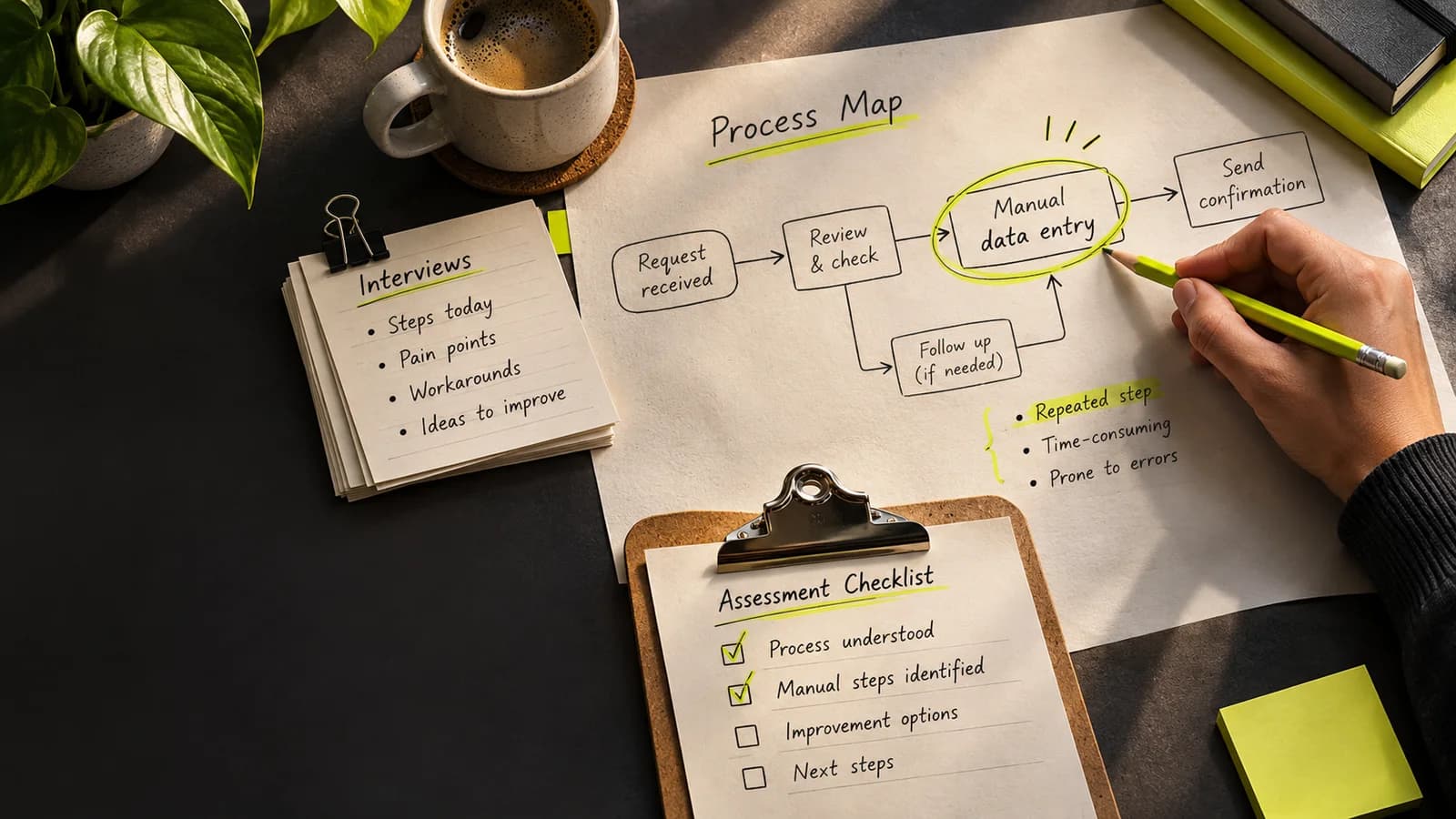
The scope, deliverables, and decisions behind a focused assessment of one department and up to three systems.
A fit conversation answers whether the problem is something we can help with. A paid workflow assessment goes deeper: it documents the current process, examines practical opportunities, and gives you a written plan before you approve implementation.
WHAT TO REMEMBER
- The assessment covers one department and up to three systems.
- Implementation and ongoing care are quoted separately.
- The report documents assumptions rather than promising savings.
Begin with a bounded problem
We agree which department, workflow, and systems are in scope. You identify someone who understands the work and someone who can approve decisions. We discuss access, suitable sample material, and any information that should stay outside the assessment.
Public inquiry forms are for a description of the problem. Please do not upload customer records, passwords, or sensitive documents there. If a later engagement needs access or samples, we agree the method and boundaries separately.
Understand the normal path and its exceptions
Discovery follows the work from the initial input to the final handoff. We ask what gets copied, what gets checked, what often needs correction, and how the team notices a failure.
We also review the integration options available in the systems involved. A proposed workflow must account for permissions, software-plan limitations, usage charges, and the work a person must continue to own.
Leave with decisions and a written plan
The assessment identifies three prioritized opportunities with cost, time, and risk assumptions. The report explains the current workflow, proposed changes, dependencies, and what should be measured.
You receive a walkthrough and a scoped implementation quote. You can ask questions about the tradeoffs before deciding whether to proceed. The assessment does not itself authorize implementation, ongoing support, or a software purchase.
Know what is outside the offer
This is not a certified security, legal, or compliance audit, and it does not guarantee revenue or a particular amount of savings. Any estimate depends on the information and assumptions recorded in the report.
Assessment pricing is confirmed before paid work starts. Implementation has a separate scope and schedule. If you want ongoing care, we agree coverage, responsibilities, response expectations, and fees rather than treating maintenance as an undefined subscription.
What happens after the assessment?
If you approve an implementation proposal, agree the delivery stages before building. The assessment is the plan; implementation, launch, and ongoing support are separate commitments. The following checklist sets out what to settle for your project.
| Stage | What should be agreed |
|---|---|
| Build | The first workflow, connected systems, sample inputs, and approval steps. |
| Internal testing | Normal cases, missing information, duplicate records, and failed connections. |
| Testing with your team | Who tries realistic tasks and what must pass before launch. |
| Launch and handover | Who approves release, where instructions live, and how to pause or recover the workflow. |
| Monitoring and support | Who reviews failures, checks output quality, and approves further changes. |
Bring the workflow you want to change
You do not need to arrive with a list of AI tools. Bring a clear description of the work: preparing quotes from spreadsheets, answering calls while updating records, or rebuilding company reports. Identify who does it today and who would review the result after automation.
The mechanic, dumpster rental, and CEO stories show three different implementation scopes. Use the closest example to explain your problem, then define your own requirements rather than assuming the same tools or results will apply.
WANT THE CUSTOM VERSION FOR YOUR BUSINESS?
Tell Silva about your workflow and tools. We will follow up by email to arrange a free consultation. Scope and pricing are agreed before paid work.
BOOK A FREE CONSULTATION